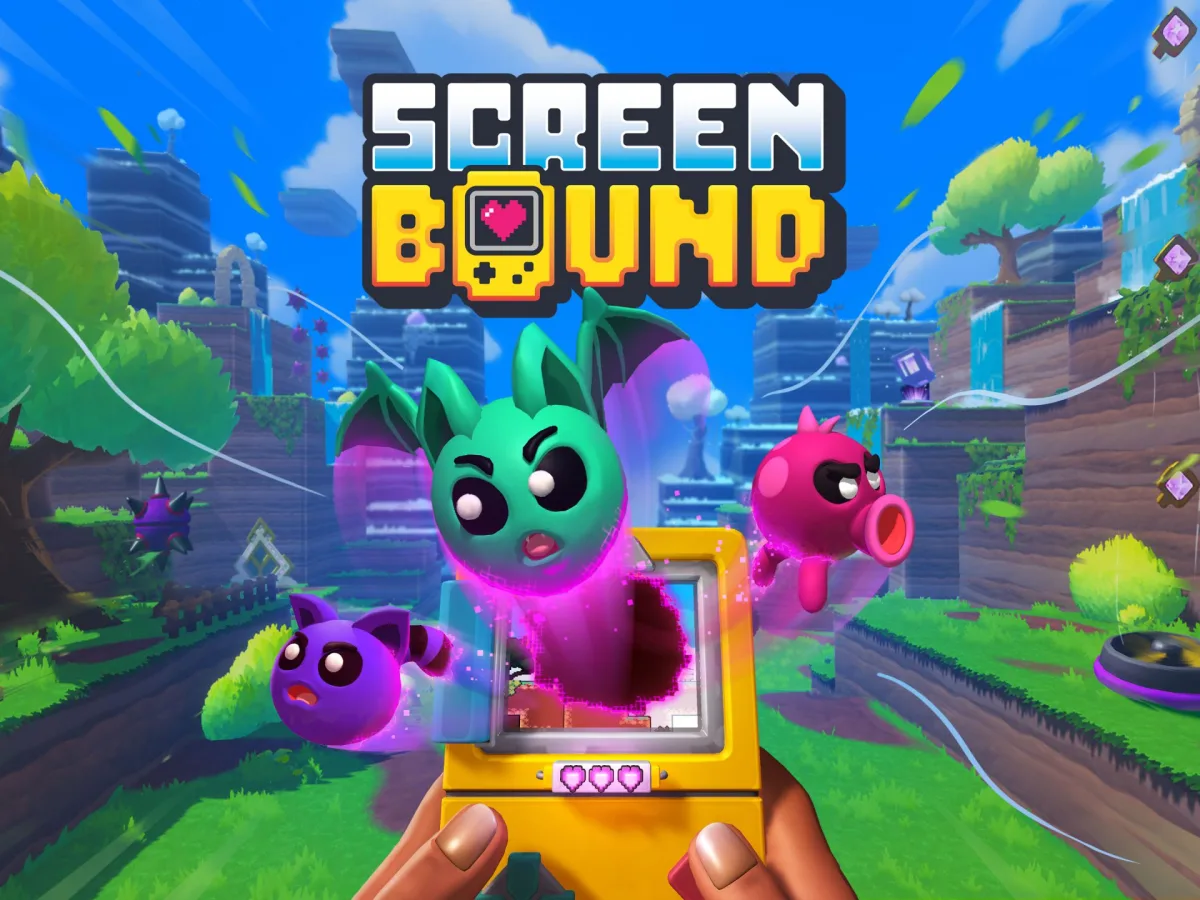
In Screenbound, a platform can be hiding in plain sight. The first-person view may show a gap; the chunky little Qboy held in front of it may show the route across. Screenbound links a stylised 3D world to a 2D game running on that handheld, with one set of inputs echoed across both. Independent hands-on reports describe doors visible in one view, platforms visible in the other, and a balloon that exists only on the Qboy screen. With the game scheduled for 10 September, that makes its central attraction wonderfully specific: the player is not simply changing perspective, but deciding which version of the room deserves their attention.
A platform in your peripheral vision
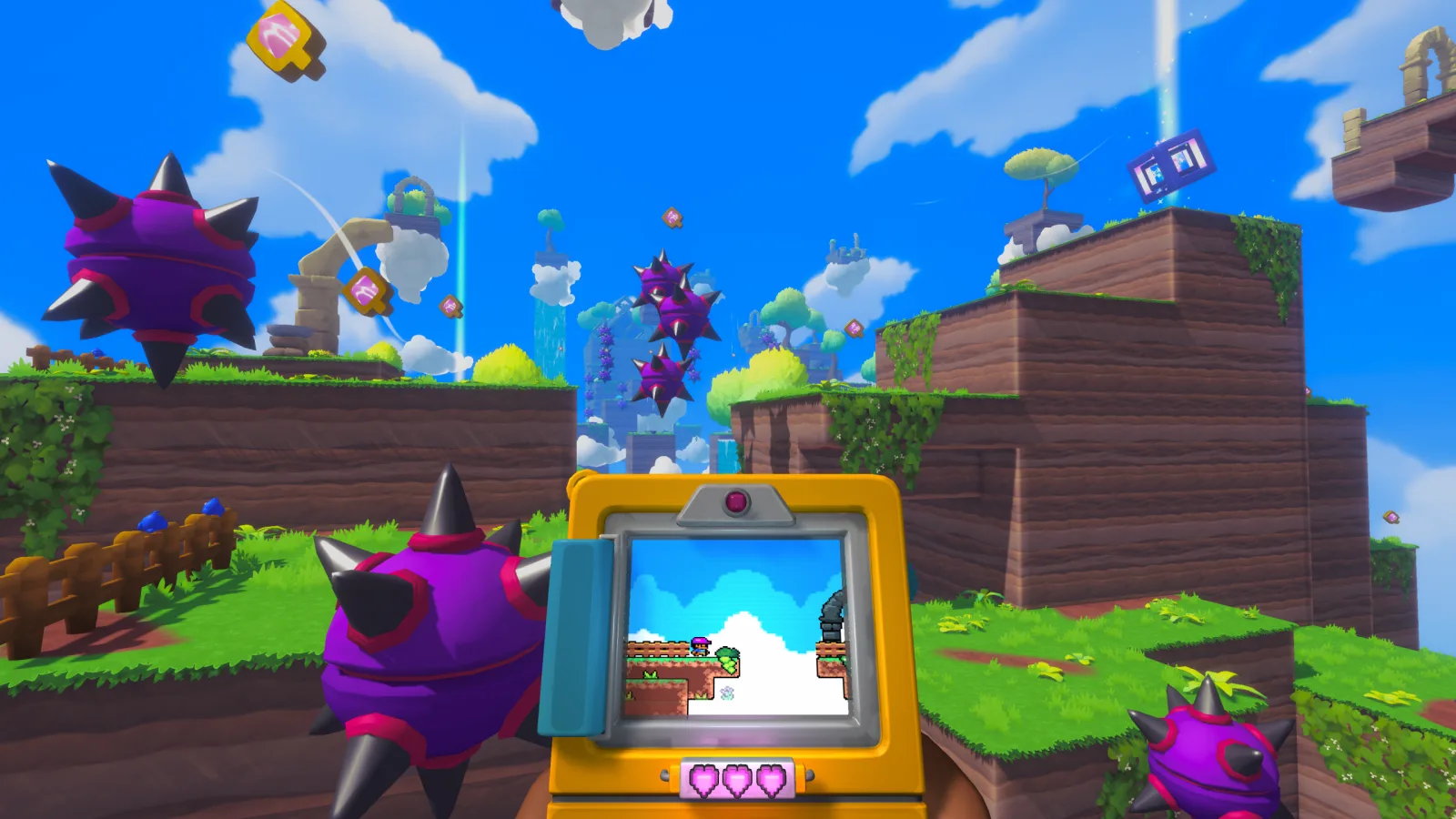
The Qboy is not a map, a scanner or a cutaway into a separate minigame. Crescent Moon Games describes Screenbound as a game in which the 2D and 3D characters move together while the rules of their worlds differ. A jump happens in both, but a ledge that looks unreachable in the large 3D space may become a usable series of tiny 2D tiles on the handheld. That gives the device a job more interesting than simply confirming the next objective. It can make the reliable-looking route suspicious and turn an apparent dead end into an invitation to look again.
Kotaku's Summer Game Fest preview gives the idea a useful piece of furniture: a balloon visible only on the 2D screen. Its string hangs low enough in the 3D world for the player to grab, carrying them over a chasm. The action is easy to understand because the two views are not competing accounts of the same scene. They are different kinds of information about a shared place. Screenbound does not ask players to solve an abstract perspective puzzle before every leap. It asks them to notice that the familiar first-person picture is missing a fact the Qboy can supply.
That distinction should make the moment-to-moment rhythm feel less like toggling cameras. SideQuesting's hands-on report describes a brick wall in 2D that becomes a walkable doorway in 3D, and a wide 3D gap that contains landing platforms in the flatter view. Each example gives the next glance a purpose. The player has a reason to scan the room, make a small judgement and commit to a movement, rather than continually checking a second screen out of fear of missing a hint. A good platformer teaches its spaces; Screenbound has the chance to teach two visual languages at once.
When the Qboy earns the glance
The immediate worry is obvious. A second moving image can become visual homework, especially in a game that also expects jumps, fights and route-finding. GamesRadar's report from a GDC demo says players can move the Qboy around the screen instead of accepting a fixed, Nintendo DS-style position. That is a small interface choice with a large player-facing effect. A device that can sit in a comfortable corner feels like part of the player's field of view; one locked over a crucial ledge would turn every clever puzzle into an argument with the layout.
It also explains why Screenbound's more grounded pitch is stronger than the developer's "5D" label. The useful question is not how many dimensions the game claims to have. It is whether the Qboy can make looking between two spaces feel natural enough that a player spots a ladder, doorway or enemy in time to act on it. GamesRadar reports that the demo introduced positioning the handheld early, while producer Will Buckle described comfort as a core goal. That is the right priority. A dazzling concept only becomes a platforming mechanic when the player can keep both its images legible under pressure.
There is a pleasant design honesty in putting the complication on screen. Most platformers hide their missing route somewhere in the level and wait for the player to stumble across it. Screenbound can put the alternative view directly in the player's hands, then make the hard part the relationship between the two. A route in 2D still has to be judged from a 3D body, and a clear-looking 3D path may conceal a hazard the smaller screen reveals. The Qboy is therefore not a rescue button for a confused player. It is another source of doubt, one that can reward a calm second look.
Cartridges can change the grammar
The first cartridge leans on side-scrolling platform language, but reporting suggests Screenbound has room to change its conversation with the player. Kotaku reports that a later cartridge will introduce a top-down view and different tools, while the official site promises new abilities as the game progresses. If that material holds together, the cartridge structure could stop the two-view trick from exhausting itself after its opening surprises. A top-down world would make distance, direction and hidden corners read differently from a side-scroller, forcing the Qboy to become a new kind of clue rather than a repeat of the same visual gag.
That is a promising way to think about progression in a platformer. New abilities often add a double jump, a dash or a key that permits a new door. Screenbound can add fresh rules for interpreting space. The player may already understand that a 2D image can reveal a platform. A later cartridge could ask what the same 3D movement means when the smaller screen is reading rooms from above. The reported plan remains a plan, and the finished game will need more than a changing camera to sustain it. Still, it is a more lively prospect than merely piling extra collectibles onto a settled trick.
Screenbound is compelling because its Qboy makes a mundane player habit - glancing away from the main action - into an action of its own. The useful leap is not only the one the character performs. It is the leap of confidence required to trust a tiny 2D balloon, a strip of platform or a doorway that the larger world does not immediately explain. Plenty of games sell the fantasy of seeing what others miss. This one has a chance to make that fantasy feel physical: a handheld in the frame, a gap ahead, and an answer waiting in the wrong-looking place.
Sources
Where this story comes from, and where you can check it.
Official sources
- Screenbound Official SiteScreenbound ↗
- Xbox WireScreenbound: Getting Our Heads Around the Brain-Breaking 5D Platformer ↗