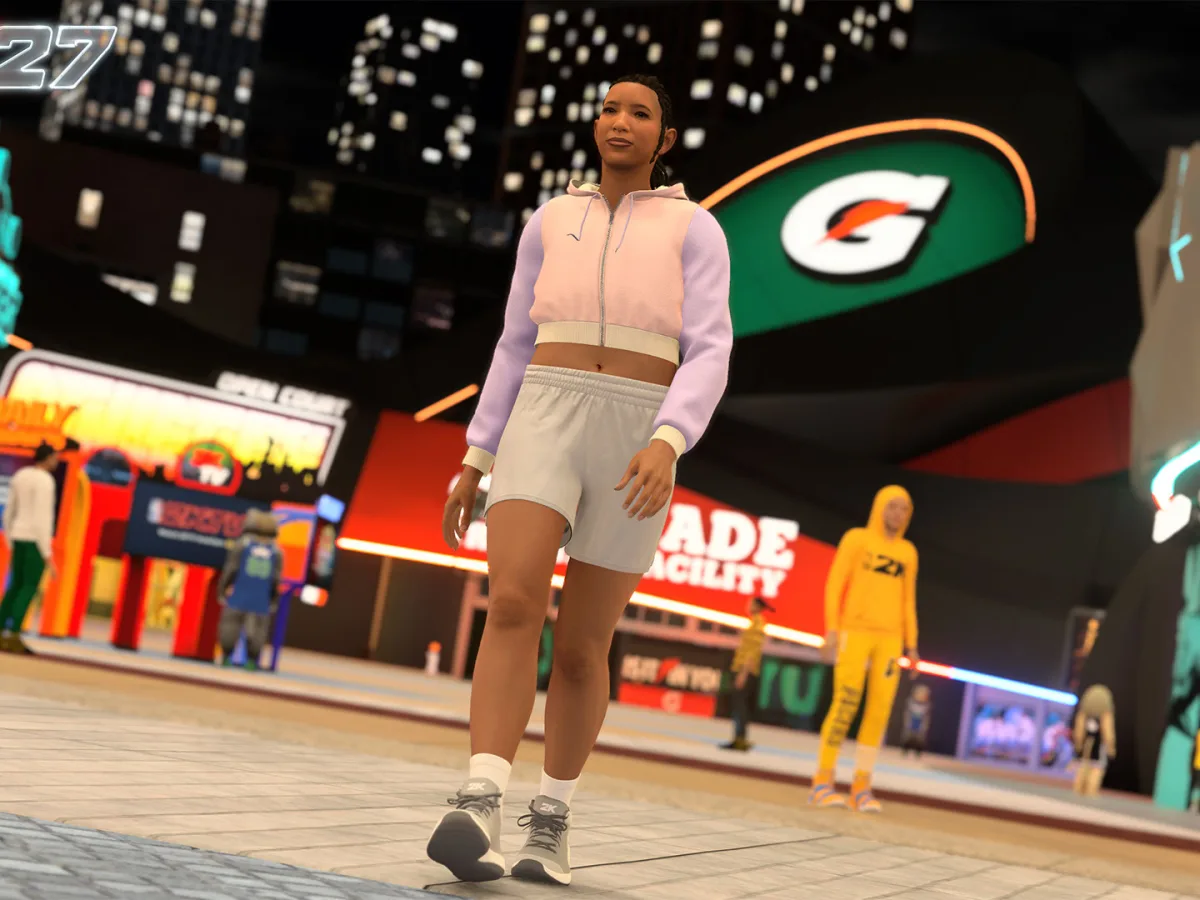
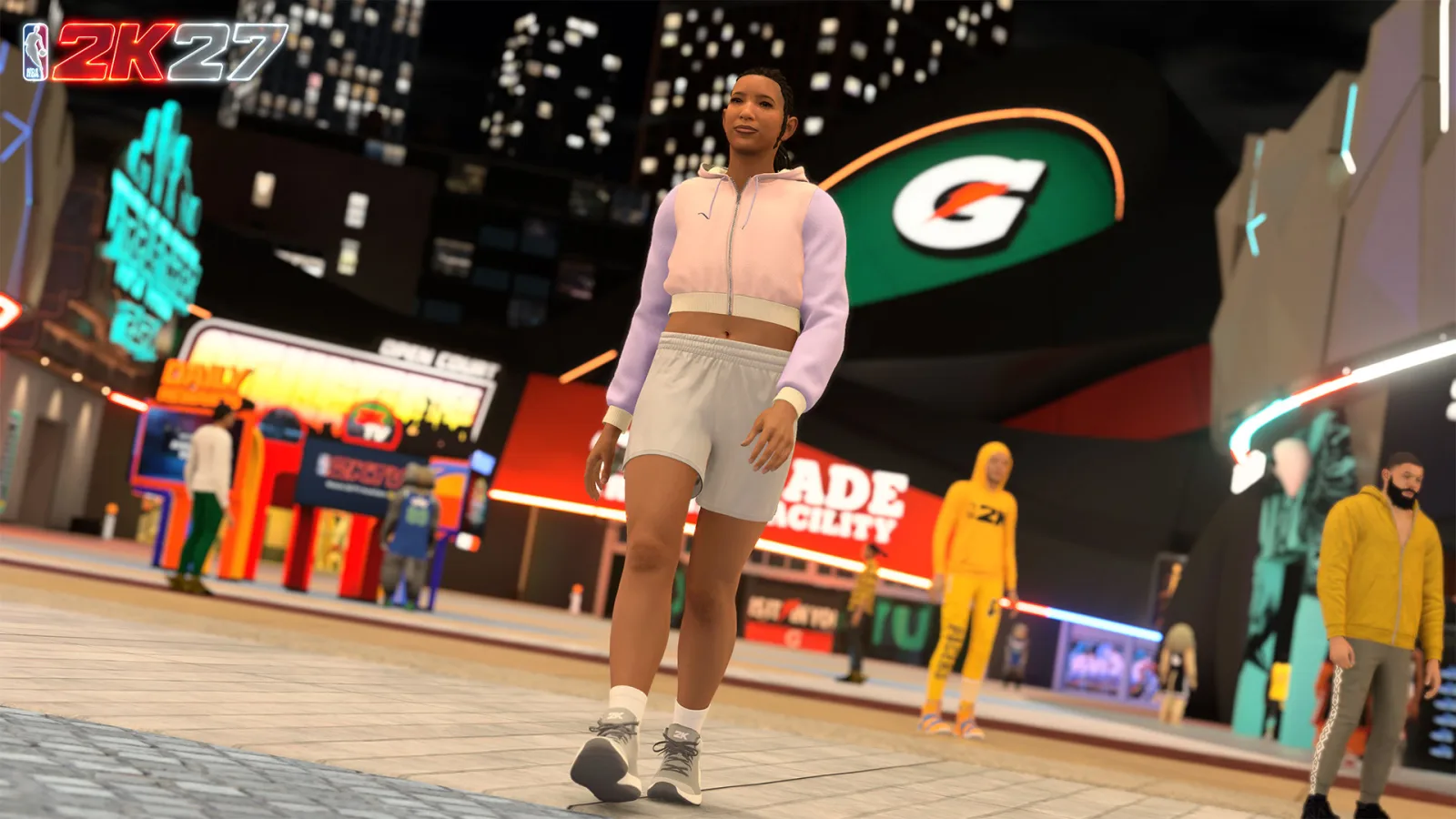
In NBA 2K27, a female MyPLAYER does not arrive in The City as a novelty character with a separate, softened ruleset. 2K says every male and female MyPLAYER uses the same framework: height, wingspan, attributes and badges come from the build, rather than the avatar's appearance. That is a quietly consequential bit of design. A shared court only feels properly shared when the choices that shape a player's job on it are shared too.
The City is one of the clearest places to inspect what this year's game thinks a basketball career should be. It is not just a plaza between matches. It contains The REC, The Theater, Park, Proving Grounds, Ante-Up and Starting 5, plus the new Crew HQ and Casual Corner. 2K's promise is simple: build a player, take that player into those spaces, and let performance rather than presentation determine what they can do. For a series that has often treated its modes as neighbouring countries, that is a more interesting ambition than another roster of courts.
A build is the common language
The practical point is not that every player will make the same kind of athlete. It is the opposite. A defensive wing, a small guard who lives at the line and a centre built to finish inside can all enter the City under rules that acknowledge the same range of decisions. The official City report is unusually explicit: appearance does not set height, badges, attribute ratings or wingspan. The game is therefore making a claim about parity in terms players can actually recognise in a menu, rather than leaving it as a slogan on a launch trailer.
It also gives the co-ed idea a useful social consequence. The same City modes are open to those builds, so a player is not being asked to leave the main competitive spaces to use a female MyPLAYER. Crew HQ turns that shared population into a more deliberate team activity, with practice courts, voice chat, private games and ranked 3v3 and 5v5 matchmaking. The feature may look like a headline change, but its better detail is structural: teammates can talk about roles, badges and matchups without first having to translate between two different systems.
The City still has a fence around it
There is a limit, and it is worth being precise about. 2K describes female MyPLAYERs as a City-only experience. That does not erase the scale of the City itself, or the fact that game-enhancing rewards can be earned there by all MyPLAYERs. It does mean the feature is a shared competitive and social space, not a declaration that every mode in NBA 2K27 has become one connected basketball life. The distinction matters most to a player who wants their created athlete to be a continuous character rather than a fresh file for each idea.
The new Casual Corner makes that boundary feel deliberate rather than accidental. 2K describes it as an optional, rookie-friendly hub for 3v3 and 5v5 games, sorted by Overall Performance tier. Early games can include CPU-controlled opposition; higher tiers move players towards human competition, while its top tiers stop awarding VC, Season XP, REP and badge progression. That is a sensible ramp into a loud online world. It is also a reminder that this is a designed route through the City, with progression and access doing as much work as the architecture.
Other modes make the seams more visible
Those seams would matter less if the rest of the career offered the same sense of continuity. ComicBook.com's Ricky Frech found a different result in Fire & Concrete, the new co-op MyCAREER story. He reported that its companion, Trace Miller, remains part of the story even when playing alone, and that match goals can require supporting him in ways that do not fit a created player's archetype. That is not evidence about every match or every player, but it is a revealing account of a mode that asks collaboration to become an obligation rather than a choice.
The same review reports that a Fire & Concrete build does not carry into MyCAREER Eras, even when the character looks identical, leaving progress to be rebuilt. It is a sharp contrast with the City framework. The City says the important thing is the build you have made; the career modes can still treat that build as local to a particular story. 2K has supplied many ways to play basketball this year, but the connective tissue between them remains selective. More places to compete do not automatically make a player feel more permanent.
Shared systems need shared stakes
That is why the co-ed City deserves more attention than the usual yearly list of modes. It provides a direct answer to a mundane but vital question: when people meet on the court, do their choices mean the same thing? In NBA 2K27's City, the answer is largely yes. A build's limits and strengths are attached to its numbers, and the social spaces around it give those choices somewhere to matter. It is a better foundation for a shared game than simply placing different avatars in the same shot.
The unfinished part is the wider career. A player who moves from City competition to a scripted MyCAREER path or an era experiment can still encounter a new set of constraints, characters and progression rules. That need not make each mode a failure; separate fantasies can be the point. Yet the City has raised the standard. Once the game demonstrates that a shared framework can make a created player legible to everyone else, asking that player to start over elsewhere feels less like variety and more like a break in the spell.
Sources
Where this story comes from, and where you can check it.
Official sources
- NBA 2KThe City | NBA 2K27 ↗
- 2K News UKBall Over Everything in NBA 2K27 Now Available ↗
- SteamNBA 2K27 on Steam ↗