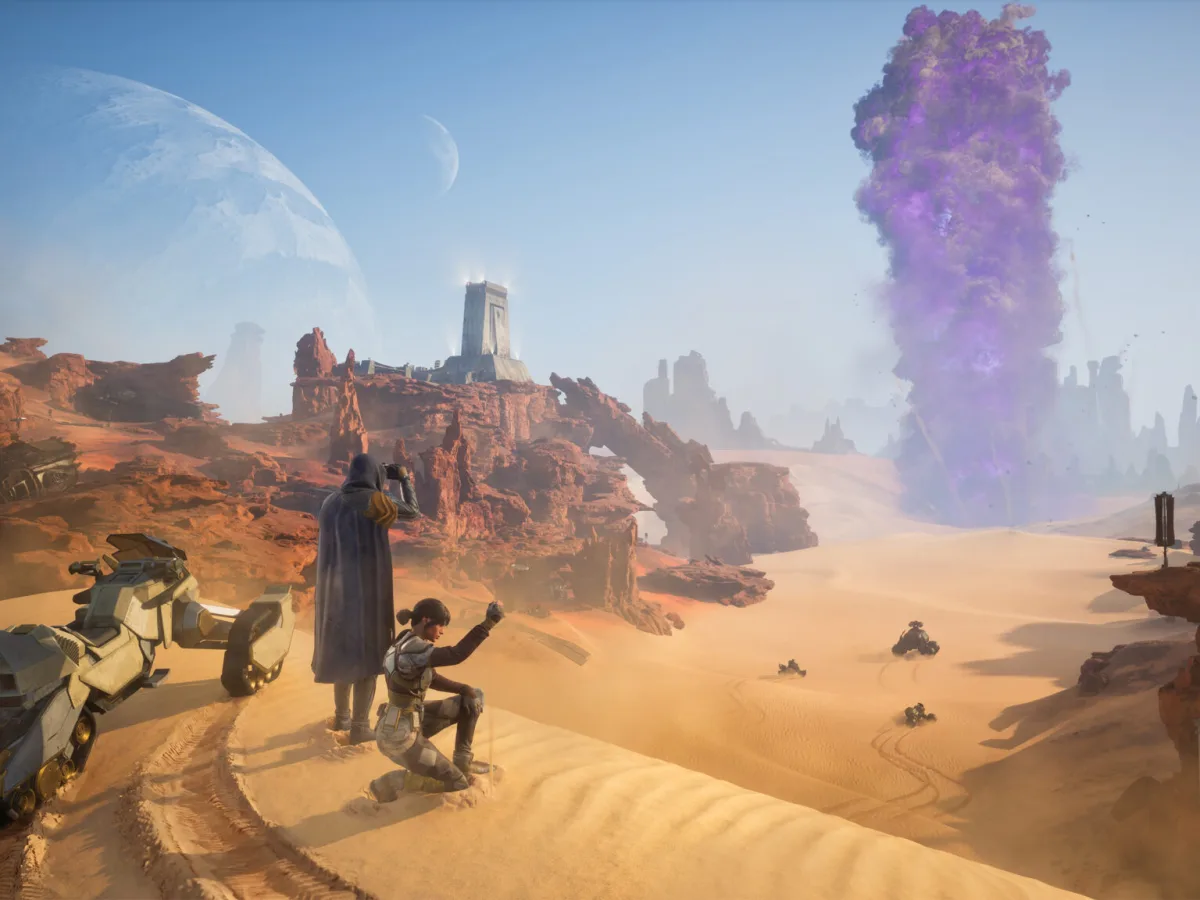
Survival games often present time pressure as if it were freedom's necessary price. A shared world can make a journey feel alive, but it can also turn a player's evening into an appointment with other people's schedules, server rules and a persistent economy. Dune: Awakening's full single-player mode, due with the console release on 22 September, is significant because it separates those ideas. It offers the same Arrakis story and survival framework with the player, rather than a live service, setting the pace. That is not a smaller version of the game. It is a different answer to what survival is for.
A mode change that affects the whole game
Funcom says the work was not a simple switch. Its June technical explanation describes moving a persistent, server-authoritative game to a client-governed one for solo play, with a lighter local database rather than the infrastructure built to track many players. That matters because an offline option that merely removes other people can expose all the systems that assumed their presence. The developer is instead promising the full story alongside adjustable harvesting, combat, survival and persistence settings. For a game whose progression includes travel, building and resource pressure, those are the rules that decide whether an expedition feels absorbing or like a clock running in the background.
The practical benefit is control over a rhythm that multiplayer games usually standardise. In GamesRadar+'s recent Gamescom reporting, Funcom chief creative officer Joel Bylos contrasted the live game's longer route through its systems with a solo experience that can be shortened by changing settings. That is not an argument that every player should reduce the difficulty. It is an acknowledgement that a fixed rate of loss, repair and extraction is a design preference, not a neutral test of skill. A player with two uninterrupted hours and a player dipping in after work can both want tension; they need not want the same amount of administrative friction before reaching it.

Choice is an access setting, not a shortcut
The best case for the mode is not that it makes Dune: Awakening easy. Arrakis should still ask a player to read heat, water, distance and the risks of moving through exposed sand. What changes is who gets to calibrate that demand. Adjustable persistence or durability can protect a carefully made base from becoming an obligation, while combat and harvesting sliders allow a player to emphasise scouting, construction or the campaign. Those options are especially useful in a game with a dense set of interlocking systems, where a new player may need room to learn why something failed before being asked to recover the cost.
There is a reasonable concern here. Difficulty settings can flatten a survival game if they make every shortage cosmetic, and local control cannot recreate the negotiation that comes from competing or co-operating with strangers. Funcom says multiplayer remains central, and the settings are coming to private and self-hosted servers. That is the more promising framing: not a binary choice between the intended game and a compromise, but a set of spaces with different social contracts. Solo play can be a place to understand the map and systems; a private group can decide its own pace; public play can retain its harsher shared stakes.
Arrakis still has a social endgame
The update also arrives after Funcom has been unusually candid about the tension inside Dune: Awakening's audience. GamesRadar+'s Gamescom interview reported Bylos saying that player metrics were heavily weighted towards PvE, while the studio continues to consider more structured PvP for the future. That does not settle the design argument, but it explains why a solo mode is more than console-launch packaging. A survival world built for several incompatible appetites risks pleasing none of them. Giving PvE-minded players more agency leaves the studio freer to make public endgame play legible for people who actually want contest, rather than treating every player as a potential target.
The remaining question is whether the mode preserves the parts of survival that benefit from resistance rather than simply removing it. A sandworm, a long journey and a badly judged stockpile are memorable because they turn preparation into a story. Dune: Awakening should let solo players make those stakes manageable, not invisible. If its settings make experimentation possible without dissolving consequence, the update could become a useful model for the genre: multiplayer remains a distinct destination, while the road to it no longer demands that every curious player accept a server's timetable. That is a more generous way to let people find out whether Arrakis is for them.
Sources
Where this story comes from, and where you can check it.
Official sources
- Dune: AwakeningMaking the Single-Player Experience in Dune: Awakening ↗
- Xbox WireDune: Awakening Is Coming to Xbox on September 22 ↗
Independent reporting
- GamesRadar+Dune: Awakening lead says 100 hours isn't bad to get out of the survival MMO, but its new single-player mode gives you full control over the experience and time you spend ↗
- GamesRadar+Dune: Awakening's players might be 80% PvE, but devs are considering ways to spice PvP up in the future with faction versus faction and more ↗
- PC GamerDune: Awakening has decided it's not an MMO anymore ↗