
A flat is usually where a horror game lets the player breathe. In BrokenLore: DON'T LIE, Junko's flat is the problem. The newly released psychological-horror chapter begins with a shut-in protagonist, messages and files to examine, then lets familiar rooms buckle under memories she has tried to keep sealed away. That is a far more pointed use of a domestic setting than treating it as a quick prologue before the monsters and corridors arrive. The game makes a small living space carry the weight of a life lived by withdrawal.
Wired Productions and Serafini Productions released DON'T LIE on PC, PlayStation 5 and Xbox Series X|S on 10 September. It is the fifth BrokenLore chapter, but the official Steam description calls it a standalone story, while the publisher says it also reveals another perspective on events in BrokenLore: DON'T WATCH. That is useful context rather than a homework assignment: Junko has appeared in the wider series, but this instalment puts the player inside her experience. A newcomer can meet her at the flat door; a returning player has a new reason to look twice at what it opens onto.
A home that will not stay still
Serafini's starting point is concrete. Steam describes confined exploration through Junko's apartment and distorted spaces, using messages, files and environmental clues to uncover hidden truths. The official launch material calls the game first-person horror built around exploration, investigation and tension. Those details matter because they make the apartment more than set dressing. A message is a private thing until it becomes a clue. A room is a refuge until the player has to check it for what has changed. The horror does not need a mansion's worth of locked wings when its most ordinary spaces can stop agreeing with themselves.
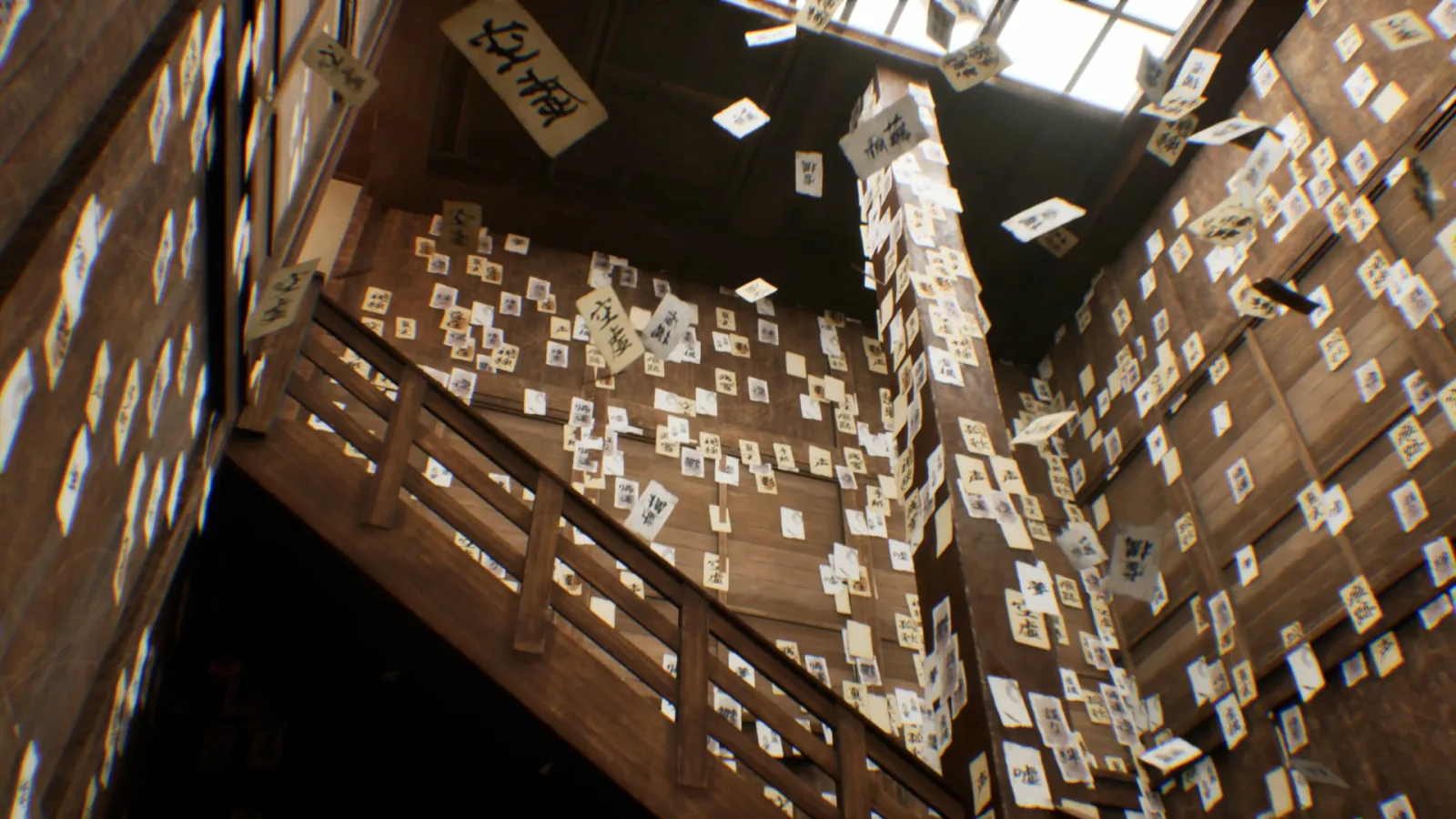
The published screenshots lean into that instability: a wooden stairwell with notes stuck to every surface, a Japanese-style room beneath a storm of leaves, spaces that look recognisably domestic before their geometry and mood turn hostile. The publisher frames the distortions as manifestations of memory, fear and perception. That is a familiar psychological-horror vocabulary, but the apartment gives it a useful constraint. Junko cannot simply be sent into a symbolic nightmare landscape with no relationship to her daily life. The game has to make the same rooms feel different enough to unsettle, while keeping them legible enough that the change itself becomes the evidence.
Investigation is the uncomfortable verb
The feature list gives Junko a less glamorous job than fighting her way out: searching, reading and noticing. It also says an unseen presence begins to track the player's behaviour, so moving carefully and staying out of sight becomes part of the equation. That choice suits a story about isolation better than an all-purpose combat loop would. Looking through a message or lingering in a room is not neutral here. The player is asked to investigate a person who has retreated from being seen, while something in the same space may be paying attention in return.
VGC's Chris Scullion played a short pre-release section at a Wired Productions event and described DON'T LIE as the most walking-simulator-like of the publisher's four horror games shown there. That observation should not be inflated into a verdict on the finished release. It does, though, put a useful name to the game's tension. Walking simulators can make a room feel like a story waiting to be read; DON'T LIE adds a threat that reacts to behaviour. If the released game sustains that balance, inspection will not only explain Junko's past. It will make the simple act of moving through her home feel exposed.

The story has a boundary
The premise needs some care in the telling. The game's press material deals in trauma, loneliness, medication and distorted perception, and Junko is described by VGC as having a psychiatric disorder. Those are loaded subjects, not a grab bag of spooky props. The publisher's account makes an ambitious claim for the setting: familiar places become manifestations of fear and emotion. The stronger reading of the game is therefore not that mental illness is itself the monster. It is that a particular character's history has made the boundaries of her life unreliable, and the player has to read that unreliability without pretending it is a diagnosis.
That limit makes the flat more interesting. It can be a home, a hiding place, a record of neglect and a scene of investigation without standing in for every experience of isolation. Sebastiano Serafini has described DON'T LIE as connected to DON'T WATCH and concerned with isolation, trauma, addiction and distorted perception. The series connection gives the story some scaffolding, but Junko's rooms give it scale. A document left in a kitchen or a route through a corridor can feel intimate precisely because the game has not built an entire city to make its point.
The smallest map is the right one
DON'T LIE's distinguishing move is not another masked figure or a louder jump scare. It is the decision to make confinement a playable condition. The flat is where Junko has made herself safe from rejection, and it is where the game's clues, changes and unseen observer can turn that safety inside out. VGC's early account found the chapter more direct and walking-simulator-like than its companions; the finished release now has to earn its own pace. What is already clear from the shipped game's materials is the shape of its best idea: horror that does not escape the room, because the room has learned how to follow you.
That is an attractive constraint for a launch-week horror feature because it says something precise about the game without claiming that its treatment is beyond criticism or that every surprise has landed. DON'T LIE is now available, but the evidence for this particular design is still plain to see: clues belong to the rooms in which Junko has hidden herself, and danger turns those rooms into a route she cannot comfortably trust. The game has made a private map out of her home. Its most unsettling promise is that the map keeps changing while the player is trying to read it.
Sources
Where this story comes from, and where you can check it.
Official sources
- Wired Productions Media PortalBrokenLore: Don't Lie is Out Now ↗
- SteamBrokenLore: DON'T LIE ↗