The latest detail on Tomb Raider: Legacy of Atlantis is not a new weapon or a shinier relic. Crystal Dynamics says players can choose the order of four tombs in its rebuilt Greece, then negotiate a more vertical and interconnected version of St. Francis' Folly. That is a useful promise because the original Tomb Raider was never memorable simply for putting Lara Croft beside ancient stone. Its rooms made players stop, look up, test a route and work out whether an apparent dead end was really an instruction. Thirty years on, that habit of uncertainty is the part a modern reimagining has to protect.
A room was a problem before it was a backdrop
The 1996 game did not have a map full of highlighted routes explaining its architecture. A switch could alter a distant part of a level; a ledge glimpsed from below might become relevant much later. That could be awkward, especially when a missed jump meant retracing a long route, but it also made geography the substance of play. The player was not merely moving Lara through a tomb towards the next story scene. They were building a working mental picture of slopes, water, locked doors and spaces above them. The best rooms asked for orientation before reflexes.
That is why Legacy of Atlantis has a more difficult task than replacing blocky caves with Unreal Engine 5 stonework. Developers can preserve the outline of a place and still change its relationship with the player. PC Gamer's June hands-on report worried that the demo's scripted chase, ready-made jump signposts and familiar third-person conventions made the old game's strangeness feel unusually tidy. That is one reporter's response to an unfinished build, not a settled verdict. It does identify the real pressure on this project, though: a remake can make traversal smoother while quietly removing the need to understand where one is.
Greece offers a useful test case
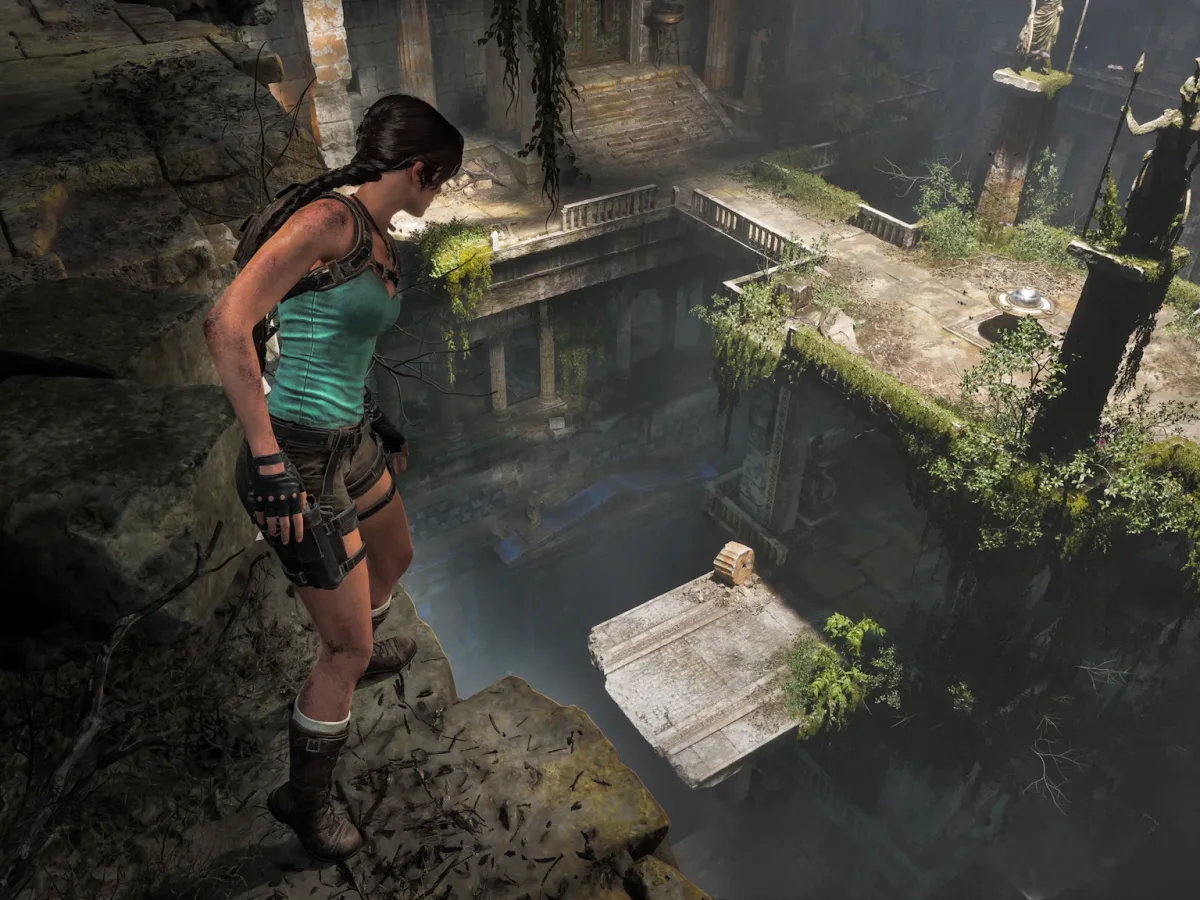
The current official account of Greece points in a more encouraging direction. Design director Jason Epps says the four tombs in St. Francis' Folly can be tackled in the player's chosen order, while the studio describes the environment as more vertical and interconnected. Those are structural choices, not merely a list of updated features. They suggest a place that can be read from several angles, where a decision about the next chamber has consequences for how the player remembers the wider vault. It is exactly the sort of relationship between room and route that a Tomb Raider level needs.
GamesRadar+'s recent hands-off report makes the point more concrete. Its Damocles Trial demonstration retained the original room's hanging swords and dangerous floor tiles: a compact puzzle that creates pressure because standing still is part of the mistake. The report says the team wants players to recognise familiar places while enhancing them for a modern audience. That is a better target than strict replication. A trial can have clearer feedback, smarter animation and more legible hazards without becoming an automatic corridor. The important distinction is whether the player still has to form a plan before they commit to a tile.
Modern movement changes the size of a mistake
Legacy of Atlantis will not play like the original, and it should not pretend otherwise. Crystal Dynamics has outlined aim assist, target snapping, contextual acrobatics and Focus Mode for combat. Those systems belong to a Lara who moves with more precision and more confidence than the deliberate, tank-controlled figure of 1996. They also change the scale of every spatial decision. If she can recover quickly, dodge in any direction and reach obvious grips with little hesitation, the level has to find new ways to make a route demanding. A rebuilt room needs more than higher walls to remain a problem.
The answer need not be punishment. The old games could confuse a player because their camera and controls were working against the space as often as with it. A modern reimagining can remove that friction and still leave meaningful uncertainty: give the player several readable options, let a failed attempt teach them something about the layout, and avoid labelling the solution before the room has had time to speak. Official footage and descriptions cannot yet show whether that balance holds across the full campaign. They do show why the Greece material deserves attention rather than being filed as another nostalgic set of screenshots.
The series has more than one past to carry
The studio is not treating Legacy of Atlantis as a direct replacement for either the original or Tomb Raider: Anniversary, the 2007 remake. Its recent character material describes the new Lara as a synthesis of classic, Legend-era and Survivor-trilogy ideas, while the project itself connects the 2013 reboot's history to her first adventure. That broad inheritance makes a clean recreation impossible, but it also gives the game a reason to exist beyond fidelity. The question is not whether every old jump or encounter survives unchanged. It is whether the new version can make exploration feel like Lara is working something out, rather than simply performing a move set.
That is the standard worth carrying into the 30th anniversary. Crystal Dynamics has set 12 February 2027 for Legacy of Atlantis on PC, PlayStation 5, Xbox Series X|S and Switch 2, so there is time for more material to clarify how its biggest spaces work. The early reports offer both a promise and a warning. Greece appears to have routes, choices and puzzles substantial enough to ask the player for attention; modern presentation can also make every answer look pre-approved. Tomb Raider does not need its old frustrations restored. It needs its rooms to leave enough unanswered that finding the way through still feels like the adventure.
Sources
Where this story comes from, and where you can check it.
Official sources
- Tomb Raider / Amazon Game StudiosReimagining Greece ↗
- Tomb Raider / Amazon Game StudiosCombat Reimagined ↗