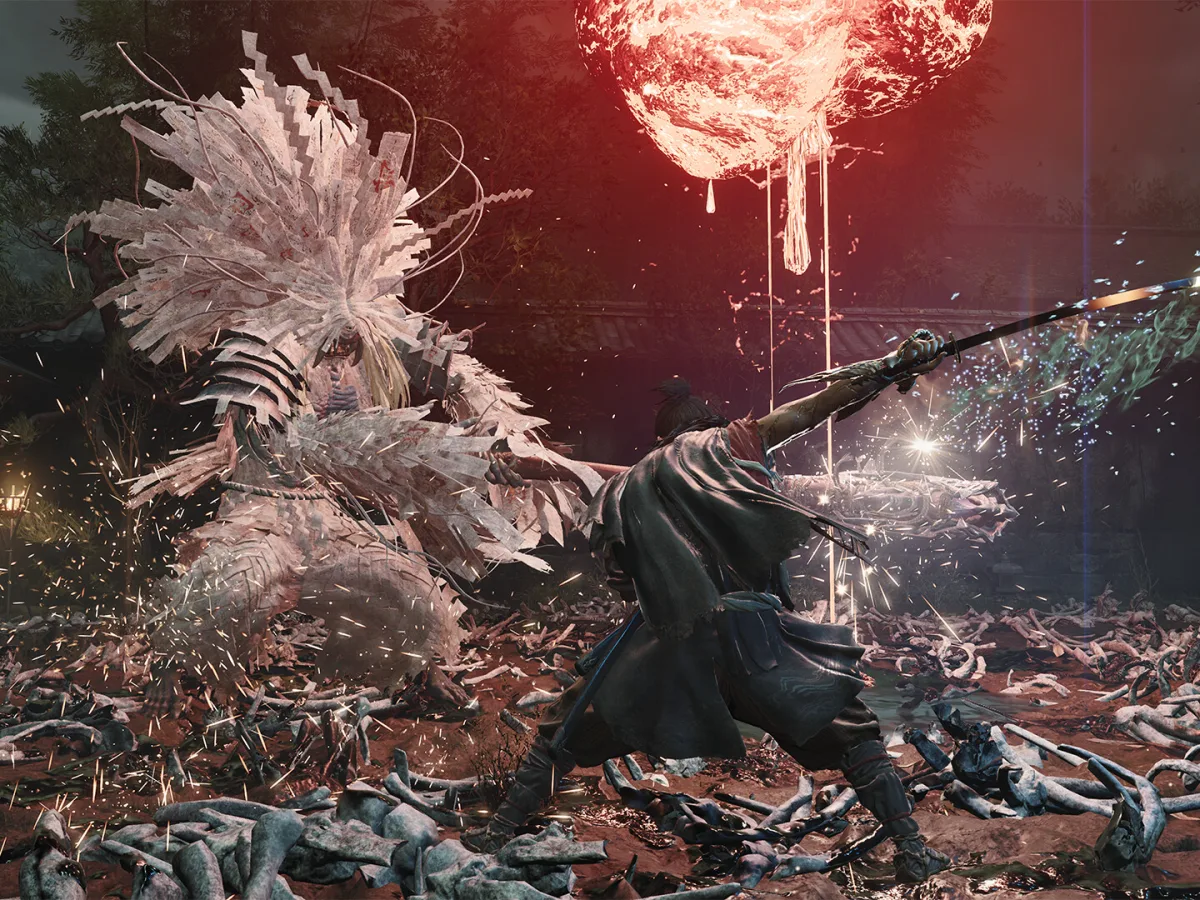
A perfect block in Onimusha: Way of the Sword does not simply stop a sword. It throws sparks, moves a meter, and tells the player which risk is worth taking next. That small chain is why Capcom's returning samurai series has found a more interesting answer to a very familiar action-game input. The guard button is only the front door. Behind it sit a standard parry, a deflect, a severe Issen counter and the occasional blade clash, each with its own timing, target and reward. The result is not a duel that asks players to repeat a trick until it works. It is a duel that asks them to read the sort of trouble arriving at Musashi's feet.
A guard that changes the next move
The basic parry is the useful first lesson because it does not demand a heroic gamble. PC Gamer's post-launch analysis describes a well-timed guard as the route into Blazing State, a temporary buff that raises Musashi's damage and stagger power. The immediate satisfaction is visual: steel meets steel, the camera acknowledges the interruption, and the enemy has briefly lost the initiative. The more important payoff arrives a moment later. A player who has used the safer answer is now being invited to spend that advantage rather than simply waiting behind the same guard again.
Deflecting supplies the next piece of the argument. PC Gamer reports that it is performed by adding another input while blocking, and that it can answer attacks the ordinary parry cannot. In its review, the outlet describes deflects draining an opponent's stamina and creating an opening for a critical strike. That is a neat distinction. The game does not present a stricter timing window merely to congratulate dexterity. It gives the player a tool whose purpose is different: standard parries maintain momentum, while a deflect can crack the defence that has made a direct attack a bad idea.
The design becomes clearer when an enemy does not respect the first two answers. Windows Central's review notes that some opponents need armour broken, some attacks need to be deflected and others need a dodge because they cannot be blocked. In other words, a raised sword is not a universal solution. The player must identify the attack before choosing a response. That keeps the action from becoming a single-button rhythm exercise, while avoiding the clutter of a combat system that makes every solution a different stance, weapon or menu. The controls remain legible because the decision is carried by the enemy's move.
The pleasure of a named risk
Issen is where Onimusha allows the whole routine to become reckless. PC Gamer calls it a counter with an extremely tight timing window and says the game places slow, clearly telegraphed swings among more ordinary attacks as an invitation to try it. The player can take the sensible parry, or see the wind-up and attempt something sharper. That choice is much more memorable than an anonymous critical hit because the game has framed it as a particular kind of answer. An Issen is not just extra damage. It is the moment a player decides they know the enemy well enough to interrupt its sentence halfway through.
That hierarchy also prevents success from becoming a dead end. The basic parry builds Blazing State, but the same PC Gamer analysis says the state depletes over time. Deflecting benefits from the powered-up blade, yet refreshing the state is easier through further parries than by rebuilding it from nothing. The system therefore loops back on itself: use the ordinary response to earn the improved one, then keep recognising ordinary openings while enjoying the stronger tool. A duel can speed up without losing its basic vocabulary.

Blade clashes give the game another way to vary that vocabulary without leaving the swordfight. PC Gamer's review describes moments when crossed blades prompt either a rapid attack input to overpower an enemy or a short exchange of light and heavy attacks before Musashi finds a way around the stalemate. It is a more overtly cinematic interruption than a parry, but it follows the same rule: an enemy action creates a specific conversational response. The game earns its lavish animations because they are tied to an interaction, not pasted over a routine finisher.
Simple inputs, particular encounters
There is a revealing source for that approach. GamesRadar+ reported that director Satoru Nihei cited Super Mario Odyssey in an interview with FZ, praising the way actions and counters affect Mario's controls and explaining that he wanted a similar tactical feel in Onimusha. The comparison makes more sense than it first appears. It is not about copying a plumber's movement. It is about making a concise set of inputs reveal more options when the player understands what is in front of them. Musashi's actions can stay straightforward while each opponent asks a different question of them.
The reviews also show the limits of that success. PC Gamer found that Way of the Sword spends a long opening stretch introducing mechanics and that its best swordplay emerges most clearly in bosses; Windows Central likewise praised the variety of boss responses while finding the connective overworld less compelling. That is useful context for the feature rather than a reason to dismiss the combat. A system built around reading a particular attack naturally shines when an opponent has a distinct pattern and enough space to reveal it. A crowd of familiar enemies cannot always carry the same back-and-forth.
When it works, Onimusha's defensive design makes a familiar sight - a sword swinging towards the player - contain a surprising amount of information. Is this the safe parry, the deflect that opens a guard, the dodge, the Issen opportunity, or the beginning of a clash? Capcom has kept the answer close to the hands, rather than burying it in a complicated build. That is why the combat feels weighty without feeling overloaded. A block is never merely a block, but it is still a block first, which leaves the player free to notice the next flicker of sparks.
Sources
Where this story comes from, and where you can check it.