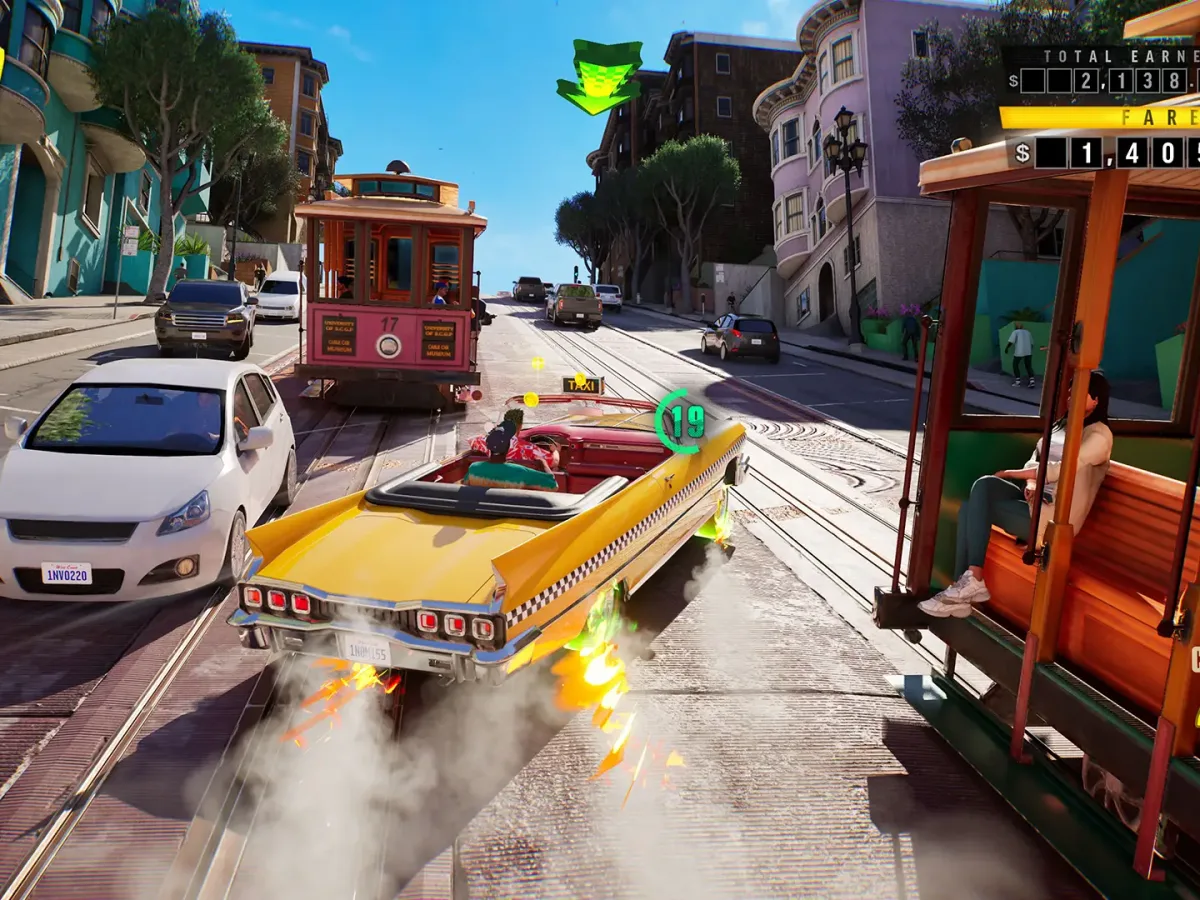
When the green number above a passenger's head reaches zero, Crazy Taxi does not hand out a consolation prize. The fare walks away, the money disappears, and the run keeps leaking away with it. That tiny cruelty is what makes the game's best moments so buoyant. A passenger delivered with a few seconds left is not just another point on a scorecard; it turns a bleak clock into breathing room for the next pick-up. With Crazy Taxi: World Tour returning timed fares inside a much larger map, it is worth remembering that the original's real spark came from making every shortcut a wager against your own future.
The setup is almost comically simple. Find a customer, stop in the marked circle, follow the arrow and arrive before their personal timer expires. Sega's PC manual makes the arithmetic plain: the remaining passenger time becomes a bonus fare, while reckless driving can add tips. Yet the important counter is not the cash total. It is the game clock that determines whether another passenger can be collected at all. A strong drop-off buys more time to keep playing; a poor route or crash can turn the next choice into a desperate salvage job. The city becomes a chain of small loans, paid back in seconds.
A fare is a route choice, not an errand
That is why the oversized arrow never makes Crazy Taxi feel like a driving game on rails. It names the destination, but it does not prescribe a route. The road may be safer. The alley, ramp, park or bit of pavement that plainly was not meant for a cab might be quicker. Each passenger changes the map's value. A downhill street that looked like scenery can become a useful line to the harbour; a cable car crossing becomes an obstacle to judge rather than a postcard. Route knowledge matters because it is exercised under a timer, and the timer forces players to decide whether a remembered shortcut is worth trusting.
The old manual's controls make that pressure physical. Crazy Dash, Drift and Back Dash are not abstract upgrades unlocked from a menu: they ask the player to shift between drive and reverse in combinations. A drift can save a corner. A botched input can throw the taxi into traffic or send it past the passenger's stop zone. The game rewards driving with tips, but it never lets style become separate from the job. A risky move may make the fare larger, leave more time on the clock, or turn a lost run around. It may also make the next ten seconds worse. That is a reason to learn difficult controls.
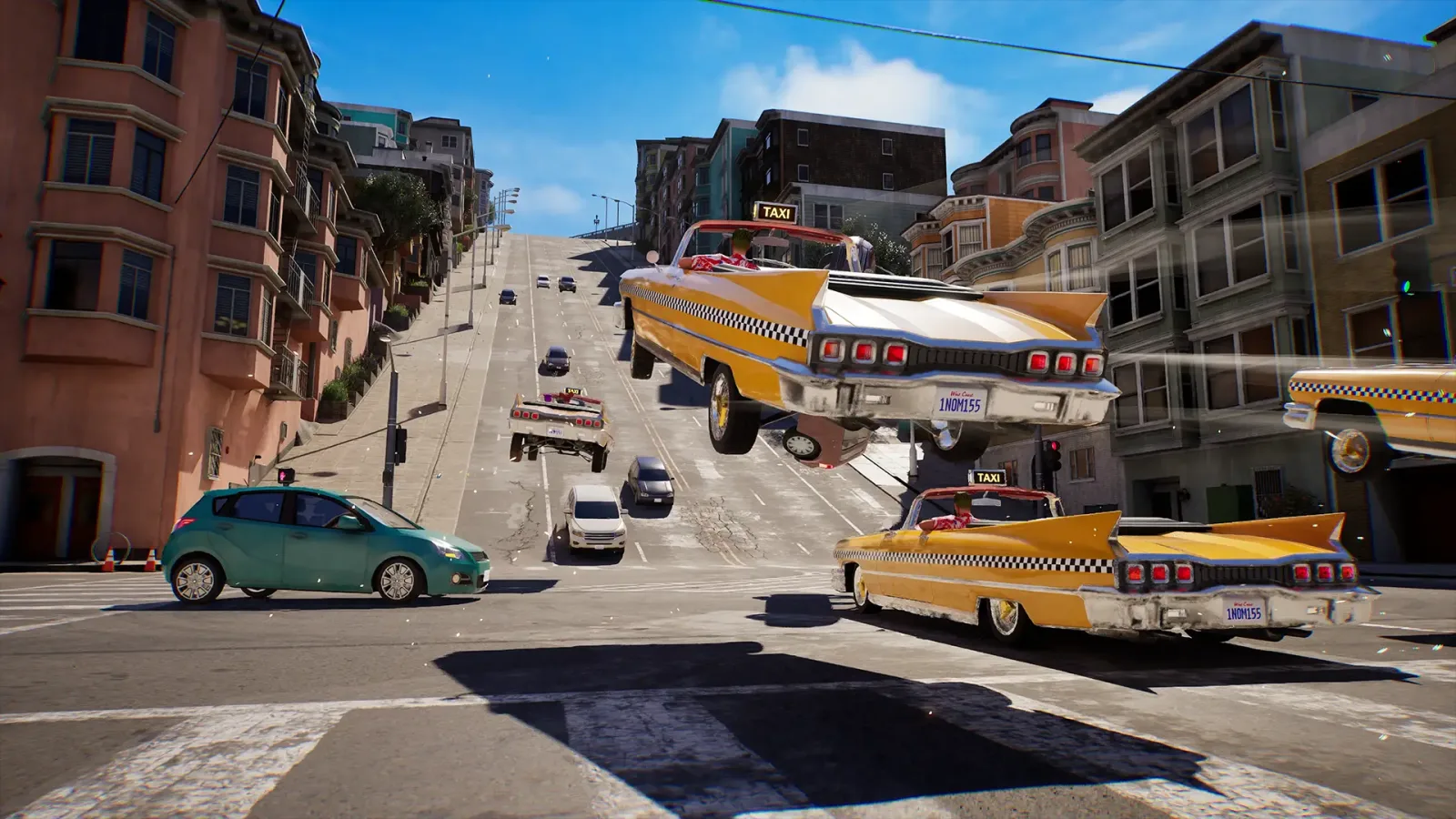
The clock makes improvement visible
Many arcade games make improvement visible at the end, when a score is compared against a leaderboard. Crazy Taxi shows it while a run is still alive. A player who learns a quicker crossing does not merely shave off a number in a results screen; they arrive with a fuller timer and suddenly have enough slack to choose a distant, valuable fare. The rhythm can flip in seconds. One confident delivery turns panic into a flourishing route; one late drop-off makes the nearest customer look sensible even if it pays less. The game teaches its city through those changing priorities, not through a tutorial explaining which lane is optimal.
This is why its broad, sunny streets remain readable at speed. The game needs players to spot a passenger, a destination arrow and a possible escape route while evaluating traffic and trying not to waste a drift. The world is noisy, but the task is clear. It never asks for a perfect drive in a vacuum. It asks whether a messy, improvised drive was good enough to buy another chance. That distinction keeps failure from feeling terminal. A missed jump stings because it costs time, but time is also the thing a smart next fare can restore. The loop is demanding without becoming a single mistake's death sentence.
World Tour has a useful old problem to protect
Recent reporting gives World Tour's return to this structure weight beyond a logo. Respec's hands-on says its Timed Modes ask players to complete as many fares as possible before the clock runs out, then grade a run and record the result. Its account describes an open world that becomes electric when a passenger gets in and the timer appears. GamesRadar's earlier preview similarly saw a Crazy Rush mode built around delivering as many passengers as possible in the shortest time. Those details preserve the original relationship between a broad city and a narrow objective: a big map is not a checklist if a fare makes only a few routes valuable.
World Tour also has campaign missions, new driving tools and activities beyond passenger runs, as previews report. They may give its spaces a different cadence, but they should not replace the timer's sharpest job. The original Crazy Taxi did not make driving fast. It made speed a way to gamble for another minute, then a customer, then a score that existed because the player had kept a run moving. That is the part worth carrying forward. A modern city can be bigger, stranger and packed with distractions. Once the fare clock begins falling, it still needs to make a shortcut feel like the most sensible bad idea in the world.
Sources
Where this story comes from, and where you can check it.
Official sources
Independent reporting
- GamesRadar+Sorry to keep you waiting: Crazy Taxi's creator knows World Tour has been a long time coming, but there are plenty of unanswered questions about this revival ↗
- RespecCrazy Taxi's open world is a great framework for its manic gameplay - and should put a smile on all but the most miserable of faces ↗