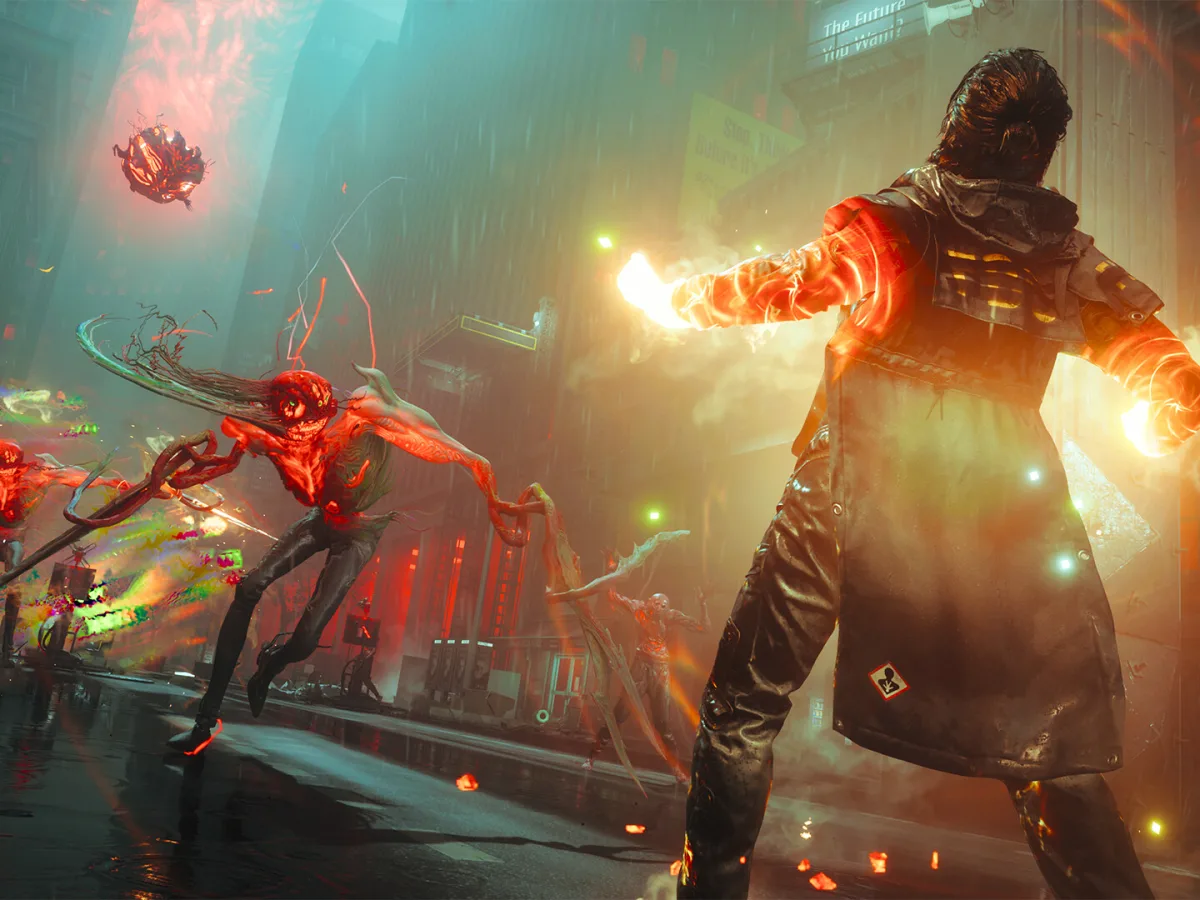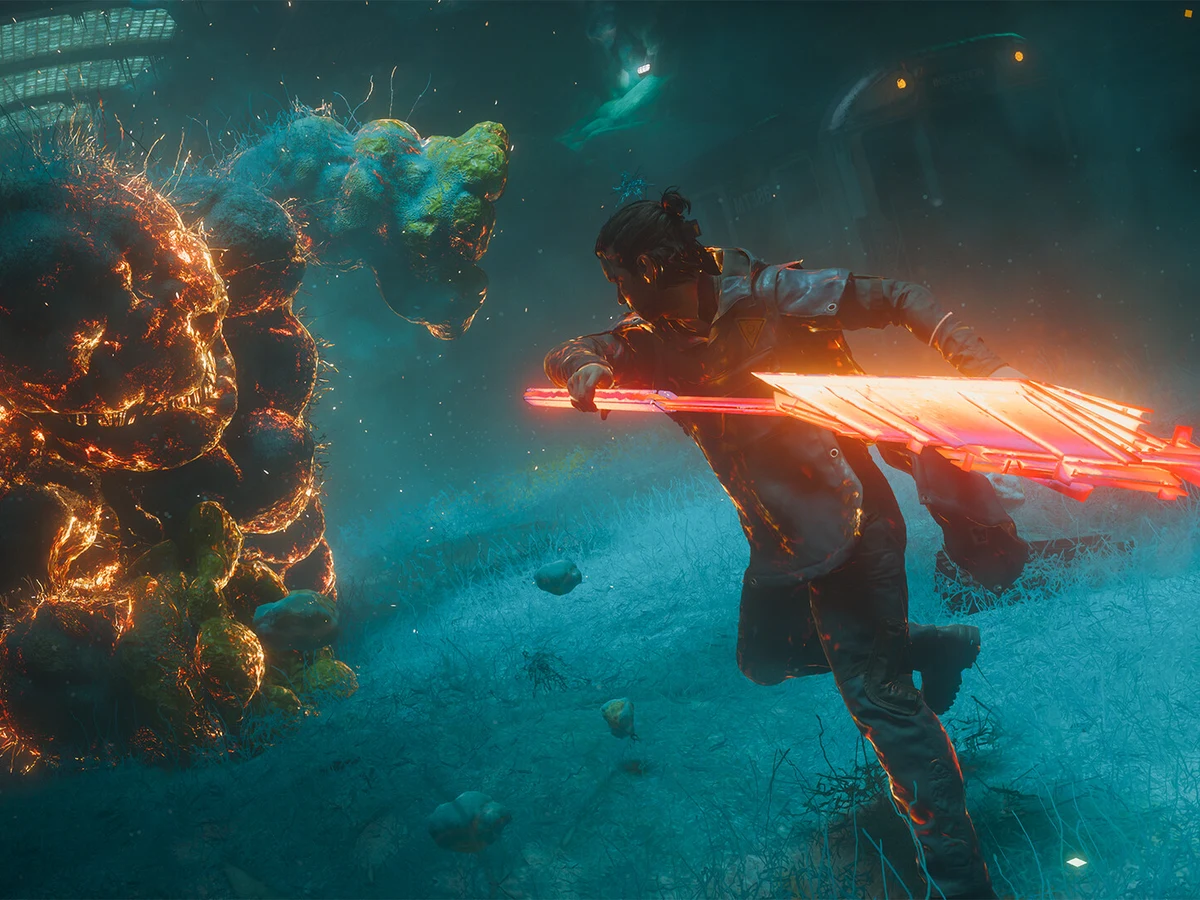
A boss made from a mound of blue Mold faces is not defeated by standing in front of it and swinging harder. In Control Resonant, preview coverage says Dylan Faden has to shift gravity, run along the arena walls and break the tentacles anchoring the creature before its weak points open. That is a pleasingly Remedy way to turn a room into a problem. The sequel's melee combat and shapeshifting weapon have attracted most of the early attention, but the more distinctive promise is that its impossible places can decide what fighting, travelling and simply getting out of a space look like. With the game due on 24 September for PC, PlayStation 5 and Xbox Series X|S, that is the part of its altered Manhattan worth watching most closely.
A fight can run up a wall
Remedy has moved this story beyond the corridors of Control's Oldest House. The studio describes Resonant as an action RPG set in a warped Manhattan, while PlayStation's game page calls out locations that play with gravity and force players to adapt their combat plans. The city is not meant to reproduce named Manhattan landmarks. Game Informer's Gamescom report says Remedy instead wants places inspired by the city and given a twisted version of its own. That distinction leaves room for a street to bend into a drop or a room to stop treating the floor as the obvious place to stand.
The previews give that idea a practical shape. Game Informer saw Dylan hunt the Mold-themed Resonant known as the Collective. Its boss arena asks the player to use a gravity shift to reach wall-mounted tentacles while dodging projectiles and summoned enemies, then attack the exposed weak points. The mechanic is not merely a traversal trick parked between fights. It changes the direction from which the player can approach the central task, the surface from which they evade danger and the route they take back to a target. A good action arena normally gives players room to move; this one can change what movement means.
That is a far more convincing reason for a reality-bending setting than an ornamental upside-down skyline. A gravity shift that only produces a handsome screenshot would wear thin. A gravity shift that lets the player reach the thing keeping a boss invulnerable turns the world's weirdness into legible play. It also gives the Aberrant's close-range focus a useful complication. Dylan must get near enough to strike, but the way there can suddenly be vertical, sideways or temporarily hostile. The room is not an interruption before the combat begins. It is part of the enemy's defence.
The place can carry the mystery
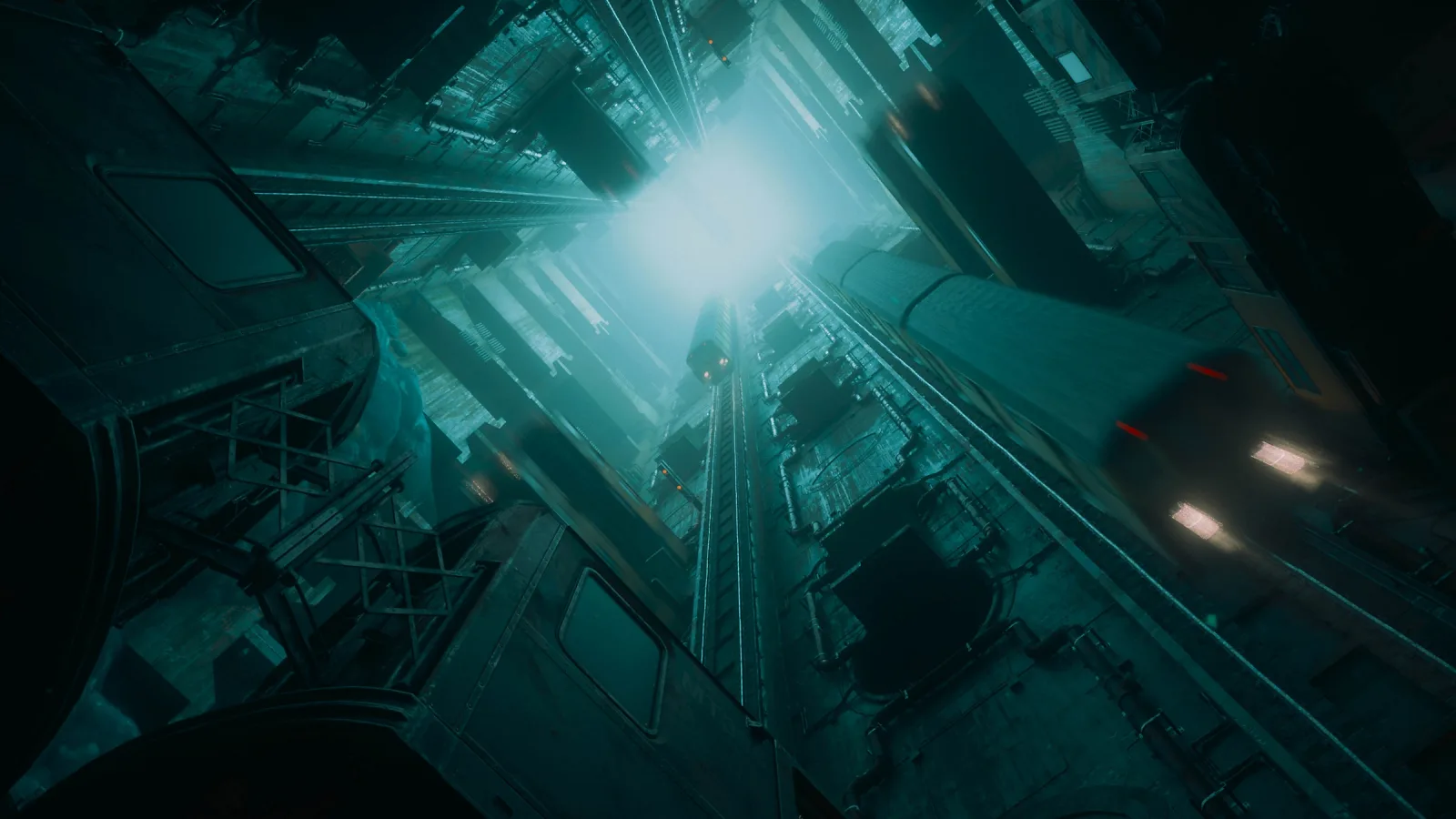
The original Control was at its best when the Oldest House made ordinary office geography feel untrustworthy: a corridor could lead somewhere wrong, a motel could become a ritual, an altered object could turn a familiar item into a nuisance. Resonant has a risk in trading that concentrated setting for a city. More space can make strangeness feel like set dressing spread too thinly. The encouraging detail from the reports is that Remedy has not treated Manhattan as a conventional open-world map. Game Informer's June hands-on describes it as open-ended rather than open world, with warped streets, frozen birds and a 90-degree drop built into the route.
Its richest reported sequence sounds smaller. In a later chapter, the same hands-on has Dylan descend through a sinkhole where repeating apartments become kaleidoscopic layers. He can traverse walls and ceilings during the battles there, then follow a song as it jumps from television to television through a dollhouse-like maze. PC Gamer's own preview singled out a music-led journey through living rooms, kitchens and bedrooms as the longest stretch without combat and the highlight of its demo. Neither account proves the finished game will sustain that pace, but they show the sequel understands that a strange room can be a scene rather than a corridor between reward markers.
That matters because the series has never relied on monsters alone for its unease. A floating enemy is a problem to solve; a familiar domestic space arranged just wrongly asks the player to look again. If Resonant gives its densest spaces a clear action - trace a sound, follow a changed gravity line, work out which repeated flat belongs to the route - it can preserve that attention while offering a much faster protagonist. The result need not resemble a puzzle game. It simply needs the geometry to make the player's next decision feel stranger than choosing which enemy to hit first.
Not just a new weapon set
There is a real change in emphasis here. The original game made Jesse's Service Weapon an elegant way to swap between firearm forms, while Dylan's Aberrant is a melee object that can become an axe, dual blades, a scythe and other tools. Game Informer's hands-on reports air juggles, dashes, sidearms and combo enders, with upgrades and artefacts adjusted in a hub called The Gap. That could make Resonant an energetic character action game on its own terms. It also makes the altered rooms more important. A series that has shifted from shooting at a distance to fighting up close needs arenas that give approach, escape and elevation a little personality.
The early evidence is not a guarantee. GamesRadar's hands-off Gamescom report notes that there is no block or parry and that health returns through enemy drops, a system built to reward aggressive play. That could be exhilarating when a gravity switch creates a fresh angle on a crowd, or exhausting if every encounter drives the player into the same relentless loop. The previews can only show pieces of the full balance. What they do establish is that the designers are attaching those combat rules to specific spaces: Mold-covered parks, tilted streets, rooms inside a sinkhole and arenas with targets on the walls.
That is why the most appealing image of Control Resonant is not Dylan's biggest hammer form. It is a player looking at an impossible room and realising that the next route is also the next tactic. The Oldest House made its bureaucracy feel supernatural by turning doors, lifts and offices into puzzles. Resonant appears ready to take that instinct outside, then make the altered ground under Dylan's feet - or above his head - matter when the fight starts. If that link holds together, Manhattan will feel less like a larger backdrop and more like the sequel's sharpest new ability.
Sources
Where this story comes from, and where you can check it.
Official sources
- Remedy EntertainmentCONTROL Resonant ↗
- PlayStation.BlogControl Resonant launches September 24 on PS5 ↗
Independent reporting
- Game InformerControl Resonant Preview: Hands-On With Remedy's Surreal Take On Stylish Action ↗
- Game InformerControl Resonant Continues To Look Weird And Strange ↗
- PC GamerControl Resonant: All the key details on the sequel to Remedy's supernatural action-adventure ↗
- GamesRadar+Control Resonant looks like an exciting action-RPG, but I just want it to mess with my head ↗