Draw a path through a wall in Tiny Glade and the game can give it a door. Stack a few coloured blocks in Townscaper and a plain shape can become a house, an arch or a stairway. Neither move asks for the sort of precise architectural labour that would normally make the result possible. The pleasure is in setting a suggestion loose, then seeing the game make a persuasive case for what that suggestion could be. These are not building games that remove the player from the process. They make the player unusually important at the moment of intention, then let the system handle the fussy bit between an idea and a finished-looking place.
That bargain is easy to mistake for a very pretty shortcut. Both games are plainly interested in keeping players out of menus, and both remove the usual city-builder business of budgets, traffic and unhappy residents. But their automation does a more curious job than tidying the screen. It gives a rough action a consequence with character. A player does not select an approved door, bridge or roof from a catalogue. They arrange the conditions in which one might appear, and then decide whether the answer is interesting enough to keep. That little pause turns procedural decoration into a conversation.
A rule with a sense of timing
Townscaper is the brisker version of the idea. Its official description calls it a town-building toy: choose a colour, place a block on its irregular grid, and watch the underlying algorithm turn configurations into houses, arches, stairways, bridges and backyards. The player is not asked to understand the rulebook before placing the first tile. A cluster near the water, a stack above it, a gap between two pieces: each gesture gets a response quickly enough to invite the next one. Its rules are doing considerable work, but they arrive as a visible change rather than a lesson.
That timing matters because it keeps the result legible. If a town suddenly produced a random tower, the system would feel like a magician showing off. Townscaper instead makes its changes close enough to the player's arrangement that the player can form a theory: perhaps this gap became an arch because of the blocks around it; perhaps another layer will make a taller house. The theory need not be technically correct to be useful. It gives the next click a purpose, while leaving space for surprise. A rule becomes playful when it helps a player notice a pattern without demanding that they master it first.
Beautiful answers, not blank cheques
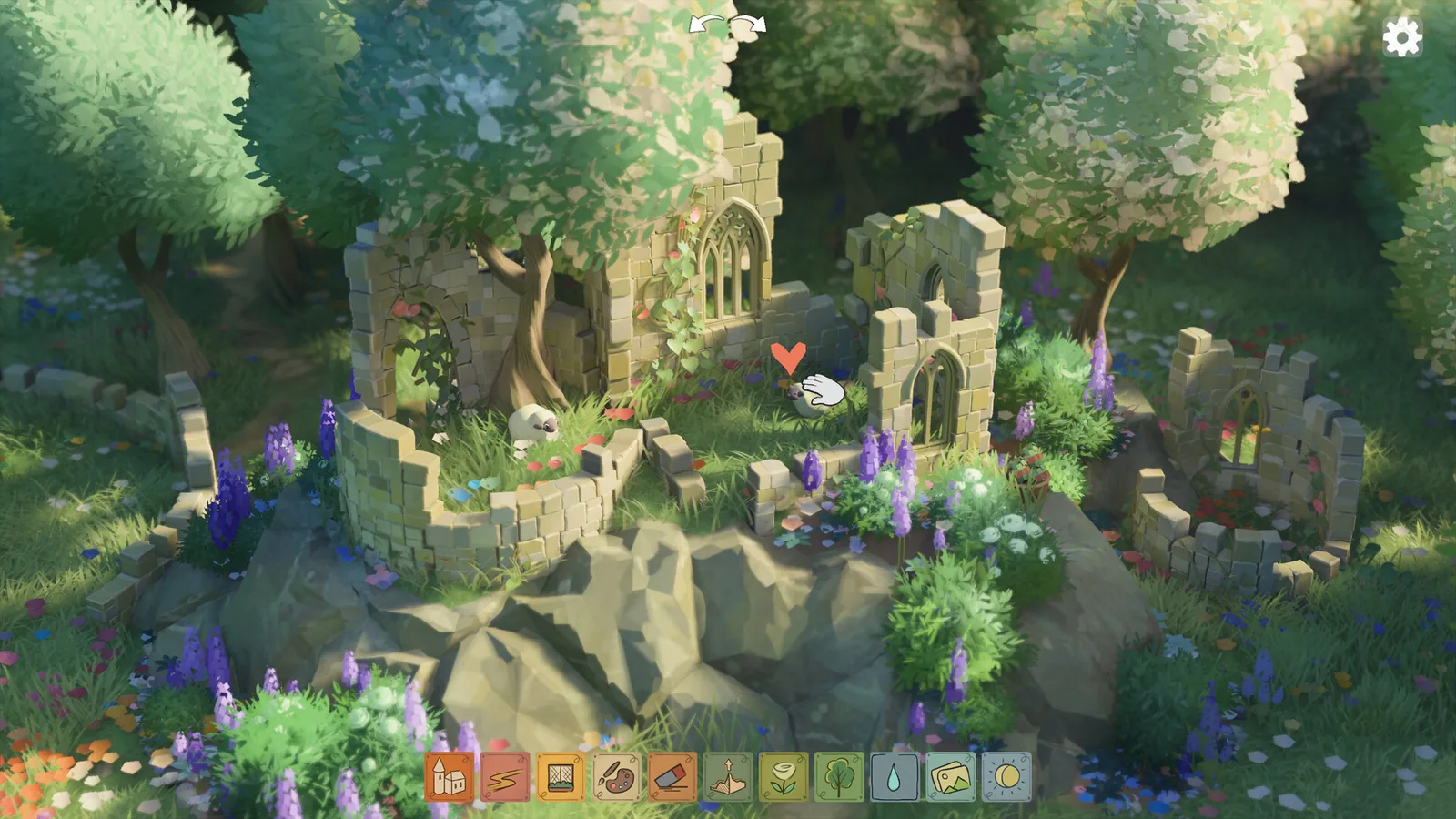
Tiny Glade gives that exchange more physical texture. Pounce Light describes a gridless diorama builder with no management, combat or goals, where buildings adapt with procedural details. Its examples are wonderfully plain: a path through a building makes a door; lifting a building brings out columns and beams. The player draws broad shapes and then watches masonry, planks and pebbles negotiate the seams. It is a clever inversion of the usual construction-game fantasy. Instead of asking for full authority over every hinge and roofline, Tiny Glade asks whether a player can enjoy setting a situation and accepting a handsome solution.
That acceptance has limits, which is why the comparison is more interesting than a simple celebration of cosy games. PC Gamer's Shaun Prescott praised Tiny Glade's low-stakes toolset but found its interventions could become restrictive, particularly when the game decided where a door belonged. That is the cost of making beauty easy. A system that turns almost every gesture into a postcard can narrow the kinds of places a player is allowed to imagine. The best procedural helper has to be opinionated enough to produce a result, yet loose enough to leave the result feeling like yours.
The player still supplies the question
Neither game solves that balance by pretending the algorithm is invisible. Townscaper practically puts it on stage: blocks change according to their configuration, and the resulting town is a record of the grid's quiet decisions. Tiny Glade is more theatrical, with a wall turning into an arch or a raised cottage suddenly acquiring supports. In both cases, automation is the visible material of the toy. The player returns because the next arrangement might prompt a new reply, not because there is a resource meter to fill or a checklist to complete.
That is why the lack of goals is not an absence of design. It shifts the question from How do I win? to What happens if I place this here? The question can be tiny: add one more block, pull a path through a wall, lift a corner of the ground. Yet it is enough to create a rhythm of proposal and response. Tiny Glade and Townscaper are generous because they make a beginner's rough sketch look considered. They stay interesting because the sketch is still the player's, and every new shape gives the machinery a fresh question to answer.
Sources
Where this story comes from, and where you can check it.
Official sources
- SteamTiny Glade on Steam ↗
- SteamTownscaper on Steam ↗
Independent reporting
- PC GamerTiny Glade review ↗